
Institutional portion subscribed 12.68 times; retail crosses quota.

For India, the goal is not simply to host another grand diplomatic gathering. It is to prove that a diverse coalition of emerging powers can still deliver.

External Affairs Minister S Jaishankar has publicly acknowledged India's intensified diplomatic efforts to resolve the Ukraine conflict, engaging directly with both Kyiv and Moscow. India is focusing on critical issues like Black Sea shipping safety, grain exports, and energy supplies, moving beyond its previous advocacy role. Jaishankar also highlighted India's historical ties with Russia and discussed the evolving global geopolitical landscape, including the repositioning of the US and the rise of China.

The FCNR (B) stratagem relies on using public money to defend the rupee. The State subsidises foreign borrowing to attract dollars. This tool requires large-scale borrowing to make a material difference against a gross external flow of $11 billion a day. A commensurately large fiscal cost falls upon the exchequer. The ministry of finance will choose how much it is willing to spend in exchange for this round number, points out Ajay Shah.

Indian benchmark equity indices, Sensex and Nifty, rebounded in early trade after a three-day slide, driven by strong buying in blue-chip bank stocks and a firm trend in global markets, supported by easing US bond yields and record foreign-currency deposit inflows.

Indian benchmark indices, Sensex and Nifty, experienced a significant downturn, with Sensex tanking 778 points and Nifty closing at a five-month low, driven by surging crude oil prices, geopolitical tensions, and fears of further interest rate hikes by major central banks.

IT services stocks have had tough two years, with prices coming under pressure from 2025 and the sell-off extending through the first half of 2026.

Left parties have strongly condemned the government's decision to impose charges on UPI payments exceeding Rs 2,000, with CPI General Secretary D Raja alleging the move was made under "US pressure" to favour foreign payment companies. Both CPI and All India Forward Bloc demand the withdrawal of this "anti-people decision," arguing it burdens consumers and merchants while undermining UPI's role as a public digital infrastructure. They highlight concerns that the charges weaken India's digital sovereignty and serve commercial interests of foreign corporations like Visa and Mastercard.

Axis Bank MD & CEO Amitabh Chaudhry has cautioned that the surge in FCNR(B) deposits could lead to 'abnormal lending' as banks seek to deploy excess liquidity, while also hinting at a potential interest rate hike in the near future.

Indian benchmark indices Sensex and Nifty advanced in early trade, driven by renewed foreign fund inflows and a significant drop in crude oil prices to pre-war levels, signalling an uptrend in the market. Track Sensex, Nifty on July 7, 2026.

National Investment and Infrastructure Fund Limited (NIIF) has appointed Gauravjit Singh as managing partner to lead its global capital formation efforts. Simultaneously, PB Fintech's payment aggregator platform, PB Pay, has gone live, offering consolidated payment acceptance for merchants. In a move to enhance trade efficiency, the Directorate General of Foreign Trade (DGFT) has introduced open API integration for Certificate of Origin, allowing exporters to streamline their application processes.

Finance Minister Nirmala Sitharaman stated that India is likely to sustain economic growth of 7 per cent or more in 2026-27, continuing the pace recorded since the Covid-19 pandemic, despite geopolitical uncertainties and supply-chain disruptions.

Foreign Portfolio Investors (FPIs) have injected Rs 16,621 crore into Indian equities during the first half of August, continuing a buying spree driven by improving relative valuations, resilient corporate earnings, and expectations of softer US interest rates.

Panama's coach, Thomas Christiansen, suggests India can learn from Panama's football growth despite baseball's dominance, highlighting the need for league improvement, better facilities, and attracting top players to boost football's popularity and global standing. Midfielder Carlos Harvey also advocates for bringing in star players to increase visibility.

'India is vulnerable to the West Asia crisis in three ways: Energy costs, the business Indian companies conduct in the region, and remittances from the Indian diaspora.'

Indian benchmark indices, Sensex and Nifty, experienced a sharp decline, with the Sensex tumbling 1,247.71 points and the Nifty settling below 23,100, primarily driven by a significant spike in crude oil prices and weak global market trends.

Indian benchmark indices, Sensex and Nifty, closed higher on Thursday, breaking a three-day losing streak, driven by late buying in financial heavyweights like HDFC Bank and Axis Bank, despite persistent geopolitical tensions and crude oil prices exceeding USD 100 per barrel.

Moody's Ratings has sharply increased India's GDP growth forecast for fiscal 2026-27 to 7 per cent, making it the fastest among G20 economies, driven by economic resilience despite the Middle East conflict. However, the agency flagged significant inflation risks stemming from elevated oil prices and potential El Nino disruptions.
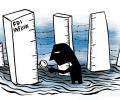
India has attracted foreign direct investment (FDI) worth approximately 4,896 crore across 29 projects since May, following the government's relaxation of norms under Press Note 2 of 2026. The revised rules permit investment without government approval from entities with up to 10 per cent non-controlling ownership by land-bordering countries.

'The fundamental issue that I have raised, how come India's GDP in current prices went down from Rs 86 lakh crore down to Rs 80 lakh crore -- a staggering erasure of Rs 6 lakh crore. This disappearance of Rs 6 lakh crore has not been answered by anyone.'

Foreign Portfolio Investors (FPIs) injected Rs 12,921 crore into Indian equities during the first week of August, extending their buying spree, driven by improving macroeconomic conditions, expectations of US rate cuts, lower crude oil prices, and a stable rupee.
Indian benchmark indices, Sensex and Nifty, experienced declines in early trading, primarily due to selling pressure on blue-chip HDFC Bank and ongoing geopolitical uncertainties.

The BRICS summit in New Delhi brings together leaders from major emerging economies to address global challenges like trade disputes, geopolitical upheavals, and the economic impact of conflicts in Ukraine and West Asia. India, as chair, aims to position BRICS as an economic growth engine, focusing on the Global South's food, energy, and supply chain security. The summit also highlights the grouping's expansion and its growing influence in global governance.
Indian benchmark equity indices, Sensex and Nifty, experienced declines in early trade due to renewed tensions in West Asia, which led to a rebound in crude oil prices, coupled with weak global market trends and foreign fund outflows.

Analysts predict that the Reserve Bank of India's interest rate decision, the evolving situation in West Asia involving the US-Iran conflict, and crude oil prices will be the primary factors influencing investor sentiment in the Indian stock market this week.

Iranian President Masoud Pezeshkian declared that Iran will not succumb to "bullying" from the US and Israel, vowing to protect national interests amidst escalating West Asian hostilities. During his visit to New Delhi for the BRICS summit, Pezeshkian also discussed strengthening bilateral ties with Prime Minister Narendra Modi and advocated for local currencies in BRICS trade, positioning Iran as a strategic energy and transport partner.

Inflows into non-resident Indian (NRI) deposit schemes decreased by 23.24 per cent to $2.78 billion during the first quarter of FY27, down from $3.61 billion in the previous year, according to Reserve Bank of India (RBI) data.

"When you have more liquidity than good investment opportunities, there is no reason for MFs to sell a winning trade."

The Indian government has introduced a 0.4% fee on UPI transactions above Rs 2,000 for merchants, effective October 15, sparking strong opposition from political parties and traders. Despite accusations of foreign influence and demands for a rollback, the finance ministry and top functionaries have stated there will be no reversal, citing the need for a self-sustaining digital payments ecosystem.

Rising study-abroad costs are prompting families to use education loans strategically while preserving savings, liquidity and long-term financial stability, says Yogesh Rawat

This article details the quarter-century journey of BRICS, from its inception as an economic acronym by a Goldman Sachs economist to its current status as an expanded eleven-member international bloc. It highlights its growth, key historical moments, and the significance of its upcoming summit, particularly with Iran's renewed importance in discussions.

Analysts predict that the US-Iran geopolitical conflict, upcoming quarterly earnings announcements, and fluctuations in crude oil prices will be the primary drivers of investor sentiment in the Indian equity markets.

Higher US Treasury yields, particularly the 10-year yield approaching 5 per cent, pose a significant near-term risk to global equity markets, including India, potentially triggering a 'big correction' according to market strategists.

State-run ONGC plans a massive Rs 1 trillion investment in deepwater exploration over the next five years, aiming to drill 87 wells to counter declining domestic crude oil and natural gas production. The company is also establishing a trading firm and its overseas arm, OVL, is pursuing operatorship of assets in Venezuela.

Indian benchmark equity indices, Sensex and Nifty, rebounded after a two-day losing streak, driven by strong buying in blue-chip IT stocks and positive global market cues, with the Sensex climbing 330.92 points.

As the rupee weakens, wealthy families are accelerating investments in global assets.

The Reserve Bank of India (RBI) net bought $561 million in June, marking its first net purchase since February, following three consecutive months of net sales. This move coincided with a series of government and RBI measures to attract foreign capital, leading to a 0.36 per cent appreciation of the rupee against the dollar.

'Every period of excessive optimism eventually gives way to a correction, while periods of extreme pessimism often create the best investment opportunities.'

'It is not because of the war in West Asia, which began on February 28.' 'Petroleum product prices are already going through the roof. They are bound to have a serious inflationary impact.' 'A country's leadership is tested in trying times. It is here that the current leadership is failing.'
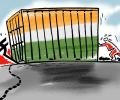
The United States and the European Union have strongly criticised India's trade policies at the World Trade Organization review, highlighting concerns over high tariffs, quality-control orders (QCOs), and restrictions on digital trade and services, which they argue undermine India's economic openness.
